





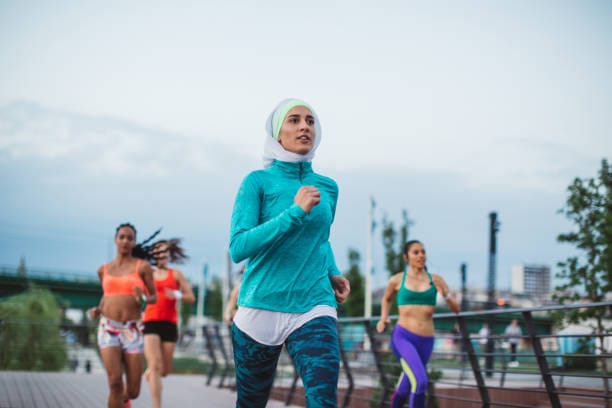
You might think that feeling hungry would be the hardest part of fasting during Ramadan. But ask most Muslims, and they’ll tell you that it’s the overwhelming pangs of thirst that never seem to go away. It’s the lack of water that makes exercising so hard during the holy month – and the thirst that can leave you feeling super low energy.
Last year, I started a vigorous exercise regimen just before Ramadan, and as a practising Muslim, I had to adjust my own physical activity and plan my diet accordingly.
It’s hard enough if you’re really into your fitness, but if you’re relatively new like me, it was hard to know if I was doing Ramadan exercise ‘right’. So, I spoke to a few Muslim fitness influencers and personal trainers to learn more about the best way to exercise while fasting during Ramadan. From the best time to get active, to the foods that provide long-lasting energy – and more.

HOW DO YOU CHANGE YOUR WORKOUTS DURING RAMADAN?
Zahra Khimji, a personal trainer and mum, needs to balance her domestic duties while ensuring her daily health targets are met. “I strength train post iftar (breaking of the fast) so that I have carbohydrate availability and energy to help me maximise the workout,” she says. “I limit the time I work out to 40-45 minutes to allow enough time for prayer before bedtime. In order to work out effectively after iftar, I consume a small meal of dates, lentil soup and freshly baked bread pre-workout. I then consume a bigger meal after working out – a mix of salad, roast chicken and couscous along with lots of coconut water helps me feel my best the next day.”
Yaz Kubba, a fitness influencer from Washington D.C, says: “I avoid exercises that will leave me too sore to pray comfortably. My sleep, hydration, and nutrition play a larger role in my performance than fasting, so those are what I focus on. I aim for a gallon of water and focus on low-sodium, high-protein meals between iftar and suhoor (dusk meal). For suhoor, I will have my usual breakfast and snack. Although I continue with my regular workouts, I always listen to my body and err on the side of caution.”
WHAT EXERCISES DO YOU DO DURING RAMADAN?
Yaz adds: “I focus on maintenance rather than improving performance or increasing intensity. I still go for long runs, lift weights, and do plyometric exercises while fasting, but I pay closer attention to how my body feels. My favourite exercises while fasting are deadlifts and leg press because they are great for drop sets and building muscular endurance. Plus, there’s nothing like having an amazing meal after leg day.”
Zarah does similarly: “I primarily focus on strength training to help maintain my current fitness level. This means focusing on the big compound lifts such as barbell squats, deadlifts, chin-ups, press ups and core training. I also drastically reduce the amount of cardio I am doing; I am pausing my half-marathon training as fasted exercise places a lot of stress on the body. As a mother of two young children, moderation is key to help me practice Ramadan safely.”
22-year-old Maryam Naz, who is training to become a personal trainer, says: “I generally go for lower intensity workouts, but increase the reps and times. You really don’t want any HIIT-style workouts that get you to sweat because it’s going to drain your energy and your body will start requiring an energy boost either from either food or electrolyte replacement.”


WHAT TIME OF THE DAY DO YOU WORKOUT DURING RAMADAN?
Fatima Musa, a runner with ASRA Club – a community space centring Muslim women in sports, wellness and sisterhood, says: “During Ramadan I go for a run around an hour before iftar. It helps knowing I don’t have to wait too long to drink and eat. It’s all about listening to your body, taking it easy, only doing shorter runs and at an easier pace – I never run for more than 30-40 minutes. I also recommend people connect with ASRA Club as we have a programme of events this Ramadan to help Muslim women keep active, spiritually engaged and motivated.”Health and fitness coach Mubarakah Ibrahim, 45, from Connecticut, usually begins her day of exercise at 6am. During Ramadan, she says: “I do cardio such as going for a run or a hike in the mornings or mid-afternoon. It’s okay to do that when you’re fasting because it doesn’t affect the effectiveness of cardio exercise, it’s all about whether or not you actually have the energy to do it. I’m also really big on resistance training. I’ve lifted weights for 15-20 years, it is absolutely an essential part of a well-rounded health and wellness programme.”



Yaz adds: “My ideal time to work out is a couple of hours after suhoor or before iftar. Over the years, I have found that my peak performance (and most of my clients’) was during those time periods. Right before or after an intense workout, it is especially important to be well-hydrated and properly fuelled. Of course, we don’t always have flexible schedules, so there is nothing wrong with working out mid-day or late evenings – as long as we continue to pay close attention to our body’s needs.”
ARE THERE CHANGES IN THE FOODS YOU EAT DURING RAMADAN, BESIDES TIMINGS?
Fatima explains: “I’m doing a plant-based Ramadan this year, so I have to make sure I’m getting enough protein through foods such as lentils and chickpeas, adequate carbs and greens, and while staying hydrated. The other difference is making sure that I eat enough and have three meals between Maghreb prayers and suhoor.”
Maryam says: “In terms of foods, high-protein and high-carb foods are the way to go. Protein aids muscle recovery – so foods such as meat, dairy, and high-protein bars and shakes. Plus, carbs are forms of slow-release energy which means they help with endurance and maintain energy levels during the day.”
For Mubarakah, diet stays the same: “During Ramadan, I do not change the way I eat because I typically eat a low-carb, high-fat, moderate protein, well-formulated diet. The only thing I change is switching my whey protein for casein protein as the latter takes longer to metabolise so your muscles are getting more protein throughout an extended period of time.”
I switch whey for casein protein as the latter takes longer to metabolise – so your muscles are getting more protein throughout an extended period of time.
HOW DO YOU RECOVER FROM YOUR WORKOUTS DURING RAMADAN?
Fatima explains: “In terms of recovery, I usually have a protein shake after a workout or run. I’ll also try to get a couple of hours of sleep in before suhoor time and then go back to sleep after fajr as that works best for me.”
Similarly, Yaz says: “Plant-based and low-sodium meals, amino acids, sleep, and percussive therapy (a massage technique to treat soft tissue pain).”
Now that we’re almost a week into the holy month, our bodies will be adapting to the demands of ascetic living. Those who are hoping to get active now should find a time that works for them – an hour before iftar so sustenance is imminent or before the pre-dawn meal. A protein shake may also be beneficial to consume as it slowly releases energy and reduces exposure to muscle damage. But listening to your body’s needs and how it reacts to activity is most crucial. After all, Ramadan is about being kinder to our communities, to our loved ones, and importantly, to our bodies.
This article was originally published on Stylist